

Have you ever obeyed God sincerely, only to wonder whether it made any difference at all?
Many Christians know that feeling. We step out in faith, serve where we can, pray faithfully, share the gospel, or labour through difficult circumstances—only to look at the results and feel discouraged. Our efforts seem small. The impact appears insignificant. We begin to wonder whether it is worth continuing.
That is precisely the situation faced by the people of Judah in Haggai’s day.
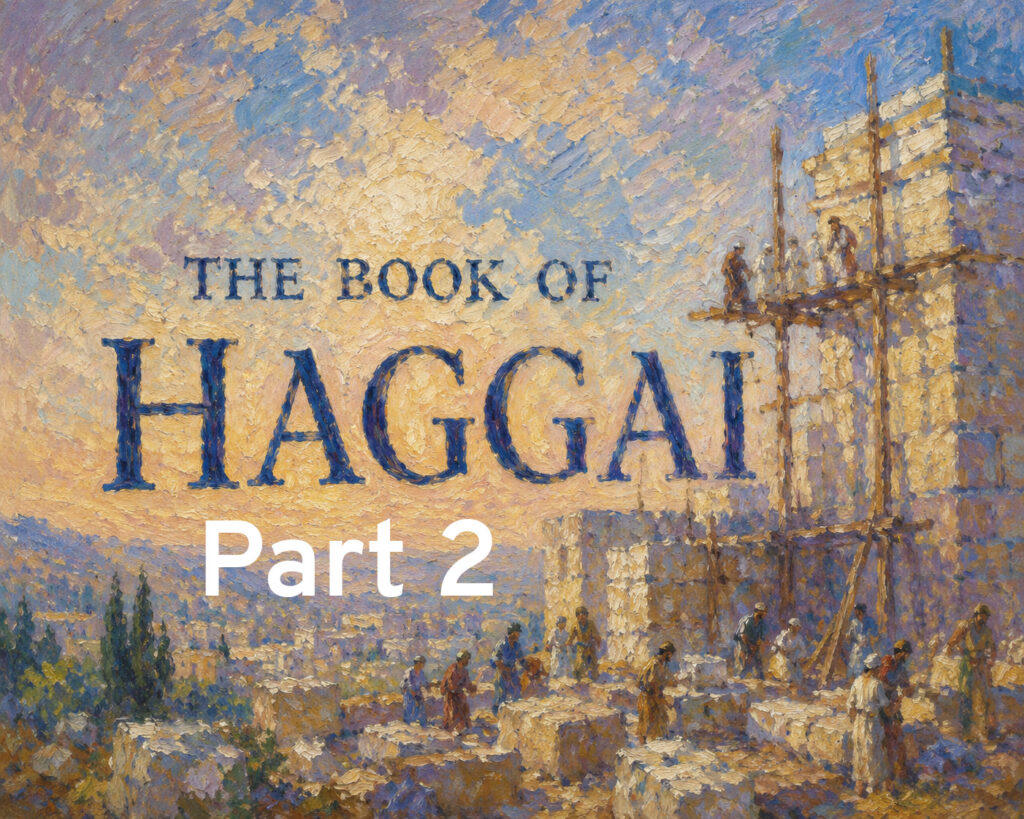
Having returned from exile, they responded to God’s call and resumed rebuilding the temple. Yet as the work progressed, discouragement set in. Some of the older men remembered Solomon’s magnificent temple and could not help comparing the two. The new temple seemed insignificant by comparison. What they were building looked like nothing in their eyes.
Humanly speaking, their discouragement made sense. Solomon had built his temple during Israel’s golden age, with immense wealth, political influence, and a workforce numbering in the hundreds of thousands. The returned exiles were a small remnant of just over forty thousand people. They lacked the resources, manpower, and prestige of former generations. The glory days seemed long gone.
Yet God did not deny their weakness or minimise their struggles. Instead, He spoke words of encouragement: “Be strong … Work, for I am with you” (Haggai 2:4).
The foundation of their confidence was not their ability, numbers, wealth, or influence. It was God’s covenant presence.
The Lord reminded them that He was the same God who brought Israel out of Egypt, the God whose Spirit remained among His people. Their task was not to measure success by appearances but to trust the God who was at work among them. Their weakness was no obstacle to His power.
God then lifted their eyes beyond the immediate project. He promised that He would shake the nations and fill His house with glory. Though the second temple would never match Solomon’s in outward splendour, its ultimate glory would be greater.
That promise was fulfilled in a way no one could have anticipated. Centuries later, Jesus Christ—the eternal Son of God—walked into that temple. The glory of God entered the temple not in a cloud or consuming fire, but in the person of Christ Himself. He was the true temple, the place where God and man meet. Through His perfect life, sacrificial death, and victorious resurrection, He accomplished what no building ever could: reconciliation between God and sinners.
Yet even this points forward to something greater still. God’s purpose has never merely been the construction of a building. His purpose has always been to dwell with His people. In the final vision of Scripture, John sees the New Jerusalem and writes, “I saw no temple in the city, for its temple is the Lord God the Almighty and the Lamb” (Revelation 21:22). The story that began with a temple in Jerusalem ends with God Himself as the temple. His people will enjoy His presence directly, fully, and forever.
The message of Haggai therefore speaks powerfully to Christians today.
God often works through weak people, ordinary acts of obedience, and seemingly insignificant efforts. The battle against sin, the patient sharing of the gospel, the hard work of restoring relationships, and faithful service in the church can all feel fruitless at times.
But God’s purposes do not depend on our strength. They depend on His presence and His faithfulness. He delights to use weak vessels for His glory, and He is accomplishing a plan far greater than we can see.
So when obedience feels small and discouragement threatens to overwhelm you, remember God’s promise: “I am with you.”
Your labour is not meaningless. Your weakness is not a barrier to His power. And the God who began His work will surely accomplish His ultimate purpose, bringing His people at last into His glorious and everlasting presence.